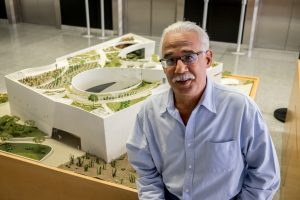
About the presentation: Socially committed museums strive to support community-building processes that contribute to community health and welfare by stimulating civic participation and building social and economic capital. This requires methods that help distinguish what a museum wants to do and what it thinks it does, with what it actually does. Drawing on our ‘museum without walls’ activities, of the Museum of Environmental Sciences of the University of Guadalajara, we have begun to develop a logic model derived from our social mission. It addresses the different needs of internal and external stakeholders, including implementers, affected populations, non-traditional publics, and users of program results, according to inputs and three levels of performance.
About the presenter: Nave Visiting Scholar, Dr. Eduardo Santana Castellón is a three-time UW-Madison Alumnus (BSc79, MSc85, PhD00). He is Professor Emeritus at the University of Guadalajara, where is director of the Museum of Environmental Sciences, and coordinator of the Socio-environmental Film Festival (FICG) and the José Emilio Pacheco City and Nature Literature Prize (FIL). For over 20 years, he has served as a visiting and adjunct professor at the Nelson Institute for Environmental Studies and the Department of Forest and Wildlife Ecology at UW-Madison. He is a Fellow at the Center for Tropical Research at the University of California, Los Angeles, and a lifetime emeritus member of the Cornell Lab of Ornithology and of the Mexican ornithological organization CIPAMEX. He has authored over 200 publications ranging from peer-reviewed articles and book chapters, to popular science and opinion pieces, and given conferences in over 130 universities, museums, NGOs and environmental agencies. He collaborates on the defense of natural resources for the Nahuatl and Wixárika indigenous communities in western Mexico and has served as an advisor to the World Wildlife Fund on conservation projects in Latin America. He has been elected to the boards of directors of the Society for Conservation Biology, the Association for Tropical Biology and Conservation, and the Aldo Leopold Foundation. He has supervised or evaluated over 55 university theses and has received—individually, collectively, and institutionally—more than 50 awards and distinctions.
Co-sponsored by the Department of Spanish & Portuguese and the Nelson Institute for Environmental Studies.