Presented by Nave Visiting Scholar, Dr. Alejandro Camargo, Universidad del Norte, Colombia.
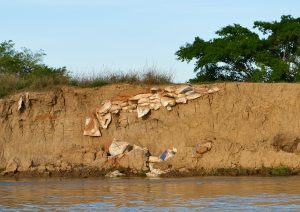
About the presentation: Sediments are materials that tell stories about the past. For climatologists, paleoecologists, and archaeologists, sediments are natural archives that preserve particles of organic and inorganic matter accumulated over time. Reading these natural archives provides insight into the climate, environmental changes, and anthropogenic transformations of the past. For historians and other social scientists, sediments serve as a metaphor for the human experience transpiring in historical time. As events unfold, experiences accrue and form different layers of varying intensities (Koselleck 2018). But what type of human experiences emerge when sediment intervenes not merely as a metaphor, but as a mundane substance that seeps into everyday life? In the La Mojana inland delta of Northern Colombia, everyday life transpires as sediment disintegrates beneath people’s feet and homes, accumulates in wetlands, clogs streams, and stores heavy metals from gold mining districts across the landscape. To address this crisis, International donors and government agents have come to La Mojana to adapt its landscapes and people to climate change. Paleoecologists and archaeologists have also been attracted to this region to read environmental histories in sediment to make claims about its present and the future in the face of climate change. Yet reading and transforming is not easy. Pollution, sediment´s constant and unpredictable movement, knowledge gaps in science, and a malleable ground that alters the paleoecological record making sediment an uncooperative material. Sediment, therefore, is a geological archive where everyday stories of accumulation, disintegration and environmental injustices in riverine environments materialize.
About the speaker: Alejandro Camargo is an assistant professor at the Department of Humanities and Social Sciences and the director of the Institute of Latin American and Caribbean Studies Alicia Dussán Maldonado at Universidad del Norte in Barranquilla, Colombia. His research analyzes how everyday life unfolds amid abrupt environmental transformations and social inequalities. he studies how different social groups, situated in different power positions, mobilize knowledge, technologies, materials, expectations, and memories to make sense of the destabilization and the reconstruction of the world around them when abrupt geological and environmental transformations intertwine with historical injustices, uneven development and global political ecologies and economies. He is currently working on a book project on the social life of fluvial sediment.